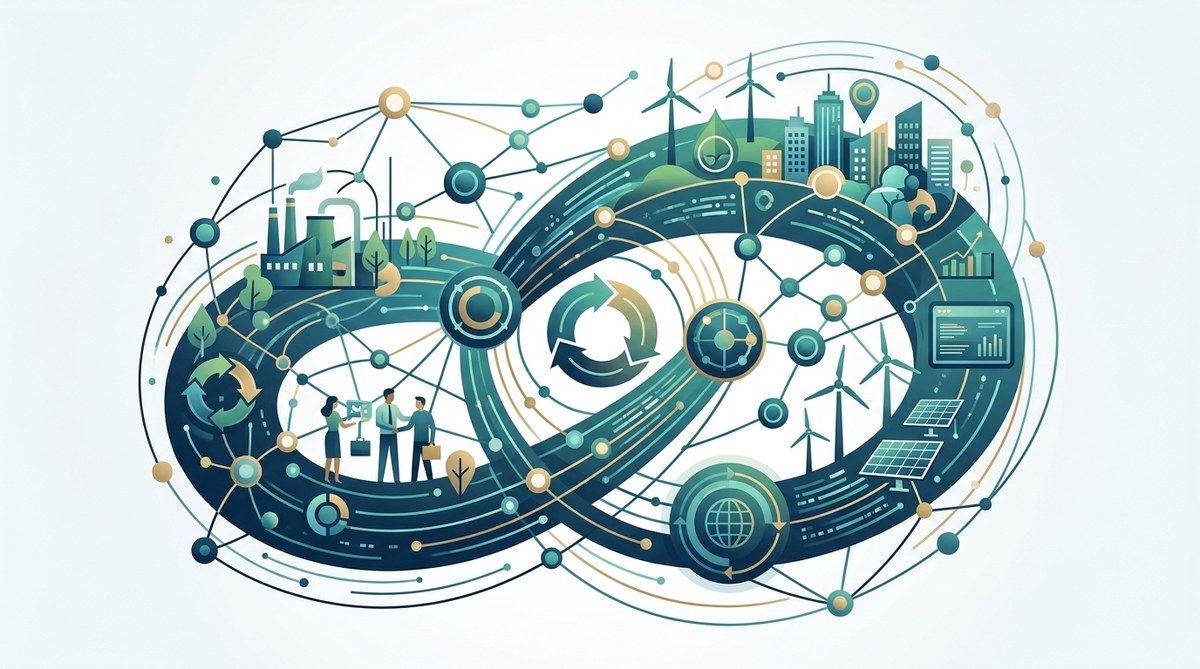
Systems thinking is transforming how we understand and shape economic models. It allows us to see beyond isolated elements and grasp the complex web of interactions that drive economies. As global challenges like climate change, inequality, and technological disruption intensify, adopting a systems perspective becomes essential. This approach helps policymakers and researchers develop more resilient, adaptable, and sustainable economic frameworks. Let’s explore how systems thinking influences future economic models and the practical steps to incorporate it into policy and research.
Systems thinking provides a holistic view of economic systems, revealing interconnected factors and feedback loops. It guides the creation of adaptable, sustainable models that address complex global issues effectively.
The role of systems thinking in shaping future economic models
Traditional economic models often focus on linear cause-and-effect relationships. They typically assume that changing one component will predictably influence others. However, real-world economies are complex, with multiple feedback loops and non-linear interactions. Systems thinking shifts this perspective, emphasizing understanding the entire system’s dynamics. It helps identify leverage points where small changes can lead to significant improvements and highlights unintended consequences of policies.
Incorporating systems thinking into economic models enhances their realism. It allows policymakers to anticipate ripple effects and better manage risks associated with economic shocks or disruptions. As sustainability becomes a core goal, systems thinking helps balance economic growth with environmental integrity and social equity. This approach supports the design of policies that are resilient over time and adaptable to changing conditions.
How systems thinking influences economic policy development
Policymakers increasingly recognize that addressing societal challenges requires more than isolated interventions. Systems thinking advocates for a holistic approach, considering all relevant factors and their interactions. For example, when designing policies to reduce carbon emissions, a systems perspective examines energy, transportation, industry, and social behavior simultaneously.
Practical processes for integrating systems thinking into policy development include:
- Mapping the system: Visualize the interconnected components and feedback loops within the economic environment.
- Identifying leverage points: Find areas where small policy shifts can produce large impacts.
- Simulating scenarios: Use models that incorporate feedback to forecast potential outcomes.
- Monitoring and adjusting: Continuously evaluate policy effects and refine strategies accordingly.
This process ensures policies are robust, flexible, and capable of addressing complex problems. It also encourages stakeholders to collaborate across sectors, fostering innovative solutions rooted in a comprehensive understanding of the system.
Practical steps for applying systems thinking in economic research
Researchers seeking to influence future economic models should adopt a systematic approach:
- Define the system boundary: Decide which components and interactions are relevant for the research question.
- Gather data on interactions: Collect information about feedback loops, delays, and non-linear relationships.
- Use qualitative and quantitative tools: Employ techniques like causal loop diagrams, stock-and-flow models, and system dynamics simulations.
- Identify unintended consequences: Analyze how interventions might produce side effects or feedback that counteract desired outcomes.
- Communicate findings clearly: Use visualizations and narratives that highlight systemic relationships to policymakers and stakeholders.
By emphasizing understanding of the whole system, researchers can propose policies and models that are more likely to succeed and sustain over time.
Techniques for fostering a systemic mindset
Developing a systemic mindset requires familiarity with specific tools and principles. Here are some commonly used techniques:
| Technique | Purpose | Common Mistakes |
|---|---|---|
| Causal loop diagrams | Visualize feedback structures | Oversimplification, missing loops |
| Stock and flow diagrams | Understand accumulation and flow | Confusing stocks with flows |
| System archetypes | Recognize recurring patterns | Applying archetypes without context |
| Scenario analysis | Test different futures | Ignoring non-linearities |
“Adopting systems thinking in economic models is not just about tools, but about changing how we see the world. It requires patience, curiosity, and a willingness to question assumptions,” advises Dr. Milan Zeleny, a pioneer in systems thinking.
Common pitfalls and how to avoid them
While systems thinking offers valuable insights, it is easy to fall into certain traps:
- Overcomplicating models: Including too many variables can obscure understanding.
- Ignoring delays and feedbacks: Missing these aspects leads to inaccurate predictions.
- Failing to validate assumptions: Relying on untested beliefs hampers credibility.
- Underestimating stakeholder influence: Not considering social and political factors reduces relevance.
To mitigate these issues, focus on clarity and simplicity where possible. Use iterative modeling, gradually adding complexity as understanding deepens. Engage diverse stakeholders early to incorporate multiple perspectives.
| Mistake | How to avoid |
|---|---|
| Overcomplexity | Start with simple models, add layers gradually |
| Ignoring feedback | Explicitly identify and analyze feedback loops |
| Unvalidated assumptions | Test assumptions with data and expert input |
| Stakeholder neglect | Involve stakeholders in model design and validation |
Applying systems thinking to build resilient economies
In a world marked by rapid change, resilience becomes a key goal. Systems thinking supports this by revealing vulnerabilities and opportunities within economic systems. For example, understanding supply chain dependencies can help design more flexible networks. Recognizing social feedbacks can inform policies that foster social cohesion and trust.
By focusing on interconnected factors, policymakers can craft strategies that withstand shocks, whether economic, environmental, or social. A systems approach also promotes long-term thinking, encouraging investments that build capacity and adaptability.
Final thoughts: embracing a systems perspective for sustainable growth
Adopting systems thinking in economic models is more than a methodological shift; it is a mindset change. It invites us to see the economy as a living, breathing system influenced by countless factors. This perspective enables us to craft policies that are not only effective today but also sustainable for future generations.
For those working towards resilient, inclusive economies, embracing systems thinking provides a powerful lens. It challenges assumptions, uncovers hidden links, and fosters innovative solutions. Begin by mapping your system, question your assumptions, and stay curious about how different parts connect. This approach can transform your understanding and impact the world around you.
Remember: Economics is inherently complex. Systems thinking offers a way to navigate that complexity with clarity and purpose. By integrating this holistic approach into your work, you help shape a future where economies serve society and the planet alike.
Leave a Reply