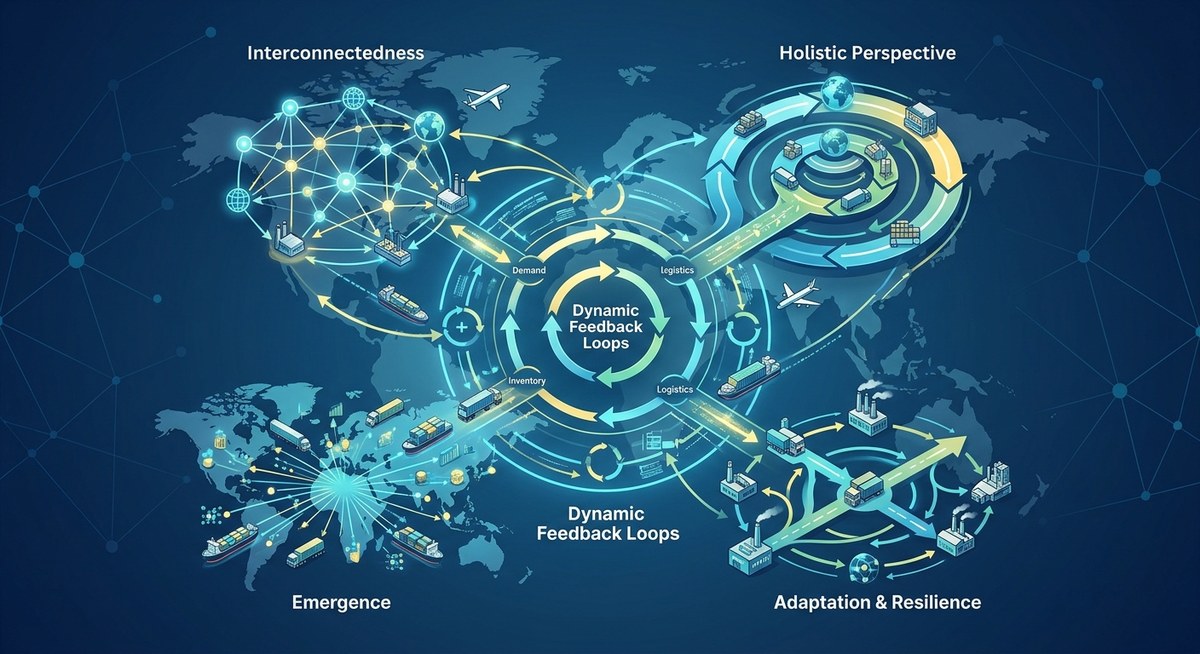
You have been managing supply chains for years. You have optimized routes, negotiated with suppliers, and trimmed inventory. Yet something still feels off. A port closure in Asia causes a ripple effect that shuts down your Midwest plant. A single raw material shortage snowballs into a company wide crisis. The old playbook treats these as isolated events, but they are not. They are symptoms of a complex, interconnected system that demands a new way of seeing. Systems thinking gives you that lens. It shifts your focus from individual parts to the relationships, patterns, and feedback loops that actually govern your supply networks. For supply chain managers, operations analysts, and strategists, these five concepts can transform how you design for resilience in 2026.
Systems thinking helps you see supply chains as living networks, not linear pipelines. By mastering feedback loops, stock and flow dynamics, system boundaries, leverage points, and unintended consequences, you can spot hidden risks, avoid repeated failures, and build adaptive supply networks that thrive in volatile global markets. These five concepts provide the foundation for that shift.
Why supply chains need systems thinking now more than ever
Traditional supply chain management is built on linear cause and effect. You assume that if you improve one link, the whole chain gets better. But global supply chains behave more like ecosystems. A small disruption in one part can amplify into a cascade of delays, shortages, and cost overruns. The typical response is to push harder on the same levers: more inventory, faster shipping, tighter contracts. Yet that often creates new problems, like higher holding costs or strained supplier relationships.
Systems thinking offers a different path. It asks you to step back and examine the structure that generates the behavior. Instead of asking “how do we fix this shortage?” you ask “what patterns of demand, capacity, and communication caused this shortage to occur?” This shift in perspective is at the heart of the five concepts we will cover. Each one is a tool you can use to rethink your supply network from the ground up.
1. Feedback loops that drive supply chain behavior
Every supply chain is full of feedback loops, yet most managers never map them. A feedback loop is a circular cause and effect where an output feeds back as an input. There are two types. Reinforcing loops amplify change, for better or worse. Balancing loops resist change and try to maintain stability.
Think about a classic bullwhip effect. Small swings in consumer demand get exaggerated upstream because each node in the chain overreacts. That is a reinforcing loop. It can cause wild inventory fluctuations. A balancing loop might be a reorder point system that triggers a purchase when stock hits a minimum level. That loop tries to keep inventory steady.
To apply this concept, start by mapping the feedback loops in your own network. Here is a practical process:
- Identify a recurring problem, such as persistent stockouts in a product line.
- List all the variables that influence stock levels: orders, lead times, production capacity, demand forecasts.
- Draw the causal connections between them. Note if they increase or decrease each other.
- Look for circular chains that create either reinforcement or balance.
- Decide where to intervene. Often changing one variable can break a destructive reinforcing loop.
For a deeper understanding of how hidden loops shape your business, check out our article on how systems thinking exposes hidden feedback loops in your business strategy.
2. Stock and flow dynamics in supply networks
Stocks are the accumulations in your system: inventory, orders in transit, cash reserves. Flows are the rates that change those stocks: production rate, shipment rate, order rate. Many supply chain problems come from focusing on flows while ignoring stocks. For example, you might push production to meet rising demand (a flow), but the stock of finished goods keeps growing because distribution cannot keep up.
A classic example is the “beer game” used in business schools. Players manage a supply chain of beer from factory to retailer. Without a systems view, they create huge oscillations in stocks. The lesson: you must manage stocks as well as flows, and account for delays in flows.
Here are common symptoms of poor stock and flow thinking in supply chains:
- Frequent expediting of orders
- High inventory holding costs despite shortages
- Long lead times that never seem to improve
- Overtime costs that spike unexpectedly
To fix these, you need to model the stocks and flows. Start by drawing a simple stock and flow diagram for your critical products. Identify where the delays are longest. Often the biggest leverage lies in reducing the delay between a change in demand and a change in production. For more on mapping causal loops and stocks, see how to map causal loops for smarter strategic decisions in 2026.
3. Setting the right system boundaries
Where does your supply chain begin and end? Most companies define their system too narrowly. They only look at direct suppliers and customers. But a resilient supply chain must consider the broader ecosystem: suppliers’ suppliers, logistics providers, regulatory environments, even geopolitical factors. The boundary you choose determines what you see.
If your boundary ends at the factory gate, you miss the vulnerability in raw material extraction. If it ends at the port, you overlook the stability of the shipping routes. Systems thinking forces you to draw boundaries that include the most influential parts of the network, even if they seem distant.
A good rule of thumb: if a disruption outside your current boundary consistently affects your operations, widen the boundary. Include that element in your analysis. This concept ties directly into integrating systems thinking to accelerate economic resilience in a globalized world. The broader the boundary, the more you can anticipate shocks.
4. Leverage points: where to intervene for maximum effect
Not all interventions in a supply chain are equal. Systems thinker Donella Meadows identified a hierarchy of leverage points. The most effective ones involve changing the goals, rules, or mindset of the system. The least effective ones involve changing flows or stocks (like increasing inventory or adding workers).
In supply chains, a high leverage point might be shifting from a cost minimization goal to a resilience goal. That changes every decision downstream, from supplier selection to inventory policy. A lower leverage point is negotiating a 2% discount with a supplier, which may provide temporary savings but does not change the system’s ability to handle disruption.
Here is a table comparing low and high leverage interventions in a typical supply chain:
| Leverage Level | Example Intervention | Likely Outcome |
|---|---|---|
| Low (changing flow) | Order more safety stock | Slightly reduces stockouts but increases holding cost |
| Low (changing stock) | Build a new warehouse | Expands capacity but may not solve coordination issues |
| Medium (changing feedback) | Implement a demand sensing system | Reduces bullwhip effect if used correctly |
| High (changing goals) | Switch supplier selection criteria from lowest cost to lowest risk | Transforms supply resilience over time |
| Very high (changing paradigm) | Adopt a circular supply chain model | Eliminates waste and dependency on virgin materials |
The key is to look for the paradigms and goals that drive your system. For a broader view of how systems thinking can revolutionize strategy, read how systems thinking can revolutionize business strategy in 2026.
“The most powerful leverage point in any system is changing the mindset out of which the system arises.” – Donella Meadows (paraphrased). For supply chain leaders, that means moving from a control mindset to a learning mindset. You cannot predict every disruption, but you can build adaptive capacity.
5. Anticipating unintended consequences
When you make a change in one part of a supply chain, it often ripples outward in ways you did not intend. A classic example: a company forces suppliers to cut lead times, but the suppliers respond by producing smaller batches, increasing unit costs, and then passing the cost back. The net result is higher total cost, not lower.
Systems thinking helps you anticipate these second order effects by mapping the feedback loops and delays. If you plan to consolidate warehouses, for example, trace through the consequences: longer delivery routes, higher transportation costs, potential service level drops. Then decide if the trade off is worth it.
A practical way to surface unintended consequences is to run a “premortem” with your team. Imagine a change has already been implemented and failed. Work backward to identify all the ways it could fail. This exposes hidden connections.
For more on how systems thinking reveals hidden patterns, see how systems thinking can uncover hidden patterns in your organization. Also consider the role of evolutionary economics in understanding how supply systems evolve over time, covered in unlocking the potential of evolutionary economics for modern business strategies.
Putting these concepts into action
You now have five lenses to view your supply chain. But a lens only helps if you use it. Start small. Pick one product line or one region. Map the feedback loops you can see. Widen the boundary to include your tier 2 suppliers. Identify a leverage point that aligns with a resilience goal, not just a cost goal. Then test a change and watch for unintended consequences.
Systems thinking is not a one time exercise. It is a practice. The more you use these concepts, the more natural they become. In 2026, the global supply environment will keep throwing curveballs. But with a systems mindset, you can design networks that bend without breaking. They will learn, adapt, and recover, because you built them to see the whole picture, not just the pieces.
Remember that every supply chain is a human system too. The relationships, trust, and communication flows matter as much as the material flows. By applying these five concepts, you are not just improving logistics. You are reshaping the way your organization thinks about complexity itself. And that is the kind of resilience that lasts.
Leave a Reply