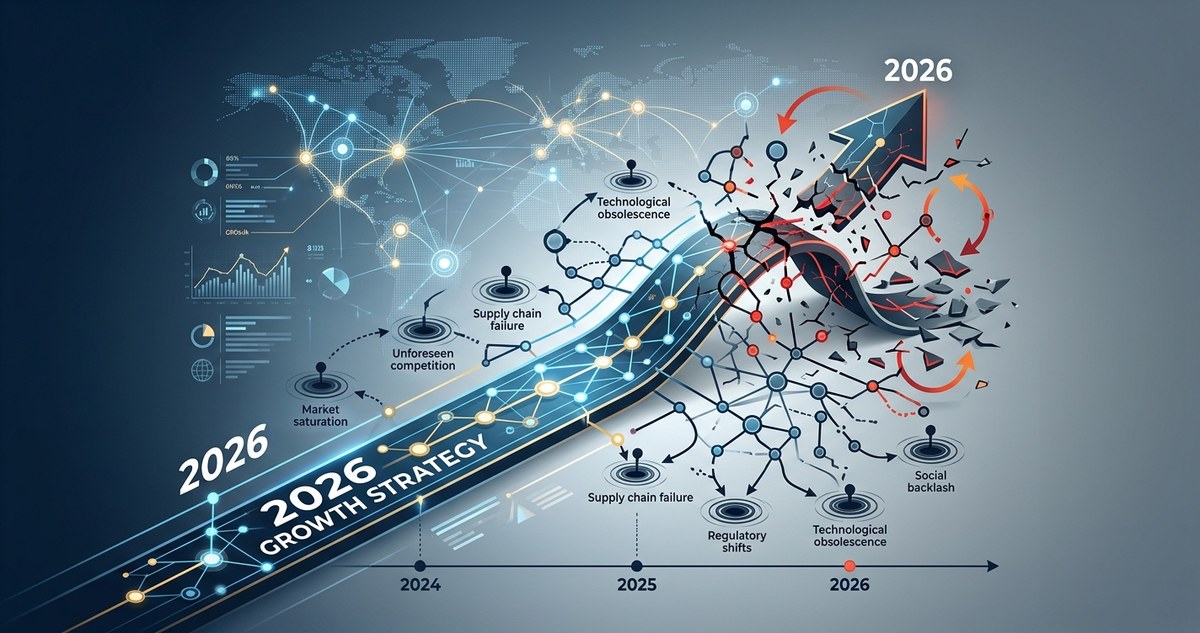
Most growth strategies fail not because the first move was wrong, but because the second and third waves of consequences were never mapped. You launch a feature to boost activation. It works. Then support tickets triple, churn rises, and your team spends the next quarter firefighting. That is the cost of ignoring second-order effects.
Leaders who plan only for the immediate outcome are building on sand. In 2026, with tighter margins and faster feedback loops, the gap between a strategy that survives and one that collapses comes down to one skill: tracing the ripple.
A growth strategy that ignores second-order effects will create hidden costs that cancel out early wins. By applying causal loop mapping and feedback analysis, senior leaders can anticipate unintended consequences before they hit. This article gives you a practical process to build a resilient 2026 roadmap that survives contact with reality.
Why First-Order Thinking Is a Trap
First-order effects are the direct, obvious results of an action. You cut prices. Sales go up. You add a referral bonus. Referrals spike. These are the numbers that make quarterly reports look good.
Second-order effects are the consequences of those consequences. The price cut erodes brand perception. Your best customers start to question value. The referral bonus attracts low-quality users who never convert to paid. These effects take longer to surface, but they compound.
The problem is structural. Most planning processes reward speed. Teams are evaluated on short-term metrics. The brain prefers clear cause and effect. Second-order thinking requires slowing down and asking, “And then what happens?” That question is uncomfortable. It reveals uncertainty. So leaders skip it.
In 2026, skipping it is no longer an option. Market dynamics shift faster. Customer acquisition costs are higher. A single misstep can cascade across your entire ecosystem.
The Anatomy of a Second-Order Failure
Consider a common scenario. A SaaS company wants to grow monthly active users. They add a generous free tier. First-order effect: signups increase 40% in the first quarter. The board is happy.
Then the second-order effects arrive. Free users flood support channels. The support team, already stretched, burns out. Response times for paying customers drop. Churn among high-value accounts rises. The product team shifts resources to build features for free users, delaying the roadmap for enterprise features. By the end of the year, revenue is flat and the team is exhausted.
The decision to add a free tier was not bad. The failure was in not mapping the delayed consequences. Every action in a connected system produces feedback loops. Some are reinforcing. Others are balancing. A growth strategy that ignores these loops is a gamble.
How to Map Second-Order Effects for Your 2026 Strategy
You do not need a PhD in systems dynamics. You need a repeatable process. Here is a four-step method designed for senior leaders who need to make decisions under uncertainty.
-
List every key action on your 2026 roadmap. Be specific. Do not say “improve onboarding.” Say “add a mandatory product tour for all new users.” Write each action on its own line.
-
For each action, identify three first-order effects. What happens immediately? Write them down. This is the easy part.
-
For each first-order effect, ask: “And then what happens?” Do this twice. You are looking for second-order and third-order effects. Be honest. Consider what could go wrong. Consider how different parts of your organization will react. Consider customer behavior, team morale, competitor responses, and technical debt.
-
Classify each effect as reinforcing or balancing. A reinforcing loop accelerates a trend (more users attract more users). A balancing loop resists change (higher demand causes longer wait times, which reduces demand). This classification tells you where your strategy will amplify itself and where it will hit resistance.
This process takes a few hours. It will save you months of recovery time.
Techniques to Spot Blind Spots Before They Hit
Mapping is only half the work. You also need to challenge your assumptions. Here are three techniques that help surface hidden second-order effects.
-
Pre-mortem analysis. Assume your 2026 strategy has failed completely. Now work backward. What went wrong? This exercise frees your team to imagine worst-case scenarios without feeling disloyal to the plan.
-
Role reversal. Assign team members to argue against their own initiatives. The product lead has to defend why the new feature will backfire. The growth lead has to explain why the viral loop will not work. This surfaces blind spots that groupthink hides.
-
Cross-functional review. Bring in leaders from support, engineering, finance, and legal. Each function sees a different set of second-order effects. A feature that looks great to product might create compliance risk that legal spots immediately.
Common Mistakes vs. Systems-Aware Responses
Here is a comparison table that shows the difference between a first-order trap and a second-order aware approach.
| Situation | First-Order Trap | Systems-Aware Response |
|---|---|---|
| Growth goal | Push for aggressive user acquisition | Map acquisition to support capacity and retention |
| Feature launch | Ship to hit quarterly OKRs | Run a pre-mortem on negative cascades |
| Pricing change | Cut prices to win market share | Model impact on brand perception and existing customer loyalty |
| Team structure | Build a dedicated growth team | Integrate growth with product and support to avoid silos |
| Data use | Optimize for a single metric (e.g., DAU) | Track a suite of leading and lagging indicators |
The left column feels productive in the moment. The right column builds resilience over time.
“The most dangerous kind of problem is the one you do not know you have created. Second-order thinking is not pessimism. It is the discipline of seeing the system before the system sees you.”
A Practical Framework for Your 2026 Roadmap
When you sit down to plan the next twelve months, use this checklist to ensure you have accounted for second-order effects.
- [ ] For each major initiative, have we traced at least two rounds of consequences?
- [ ] Have we identified which consequences are reinforcing and which are balancing?
- [ ] Have we included perspectives from support, engineering, finance, and legal?
- [ ] Have we run a pre-mortem on the strategy?
- [ ] Do we have early warning signals (leading indicators) for the most dangerous second-order effects?
- [ ] Is there a contingency plan for each major negative cascade?
If you answer no to any of these, your 2026 strategy has a blind spot.
Why This Matters More in 2026
The business environment in 2026 is defined by tighter coupling. AI agents, automated workflows, and integrated platforms mean that actions propagate faster than ever. A pricing change can be scraped by a competitor’s algorithm within hours. A product update can trigger a wave of automated support tickets before your team wakes up.
This is not a reason to avoid action. It is a reason to act with foresight. Leaders who master second-order effects will navigate volatility with confidence. Those who do not will spend the year reacting to problems they created.
For a deeper look at how to build these capabilities into your organization, read about harnessing systems thinking to drive organizational innovation. You can also explore how systems thinking exposes hidden feedback loops in your business strategy to sharpen your diagnostic skills.
Your Next Move
Start small. Pick one initiative on your 2026 roadmap. Map its second-order effects using the four-step process above. Share the results with your team. You will likely find at least one consequence that changes how you approach the initiative.
That one insight could save you months of wasted effort. It could protect your team from burnout. It could preserve the trust of your best customers.
Second-order thinking is not a luxury. It is the minimum viable discipline for anyone responsible for growth in 2026. The cost of ignoring it is a strategy that looks good on paper and fails in practice. The reward for embracing it is a roadmap that works.
Go map your blind spots. Your future self will thank you.
Leave a Reply