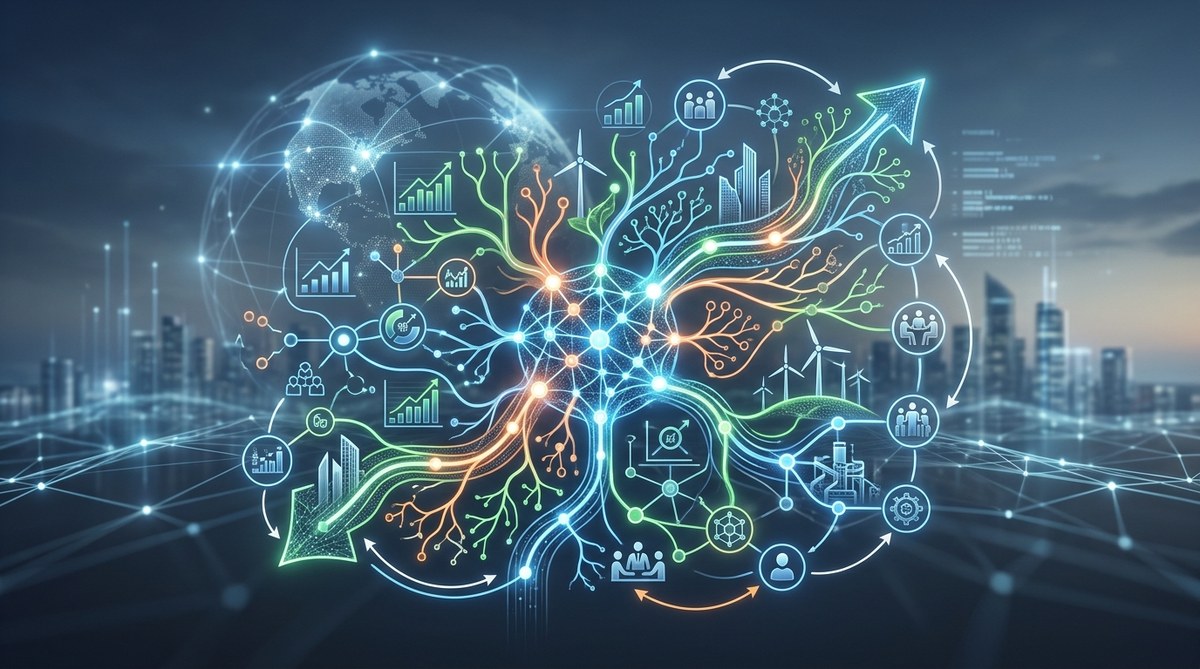
The landscape of economic systems is changing rapidly, driven by complex interactions and the need for adaptive, resilient frameworks. Traditional models often fall short in capturing the dynamic and interconnected nature of modern economies. Integrating systems thinking with evolutionary economics offers a compelling pathway for understanding how economic systems evolve over time, adapt to shocks, and foster sustainable growth. This approach encourages us to see economies not as static entities but as living networks that grow, transform, and self-organize.
The future of economic systems relies on applying systems thinking and evolutionary principles to foster adaptive, resilient, and sustainable economies. This approach reshapes how we understand change, innovation, and systemic resilience in a complex world.
Understanding Systems Thinking in the Context of Economics
Systems thinking is a holistic approach that considers the interdependence of components within a system. When applied to economics, it shifts focus from isolated markets or individual actors to understanding the entire network of relationships, feedback loops, and emergent behaviors. This perspective helps reveal how changes in one part of the system ripple through others, creating a more comprehensive picture of economic dynamics.
In the future of economic systems, systems thinking becomes essential. It helps identify leverage points where small interventions can lead to significant transformations. For instance, improving education or healthcare can have cascading effects on productivity, innovation, and social stability. Recognizing these interconnected influences allows policymakers and researchers to craft strategies that are more effective and sustainable.
The Role of Feedback Loops and Nonlinear Dynamics
Feedback loops are central to systems thinking. They describe how outputs of a system influence its future inputs, either amplifying (positive feedback) or stabilizing (negative feedback) behaviors. In economic terms, positive feedback might be seen in speculative bubbles, while negative feedback can be seen in regulatory mechanisms balancing markets.
Understanding these nonlinear dynamics enables us to anticipate unintended consequences and develop adaptive policies. For example, encouraging innovation in renewable energy involves recognizing technological, regulatory, and market feedbacks to facilitate a transition toward sustainable systems.
Evolutionary Economics as a Framework for Future Economies
Evolutionary economics views economic change as a process akin to biological evolution. It emphasizes variation, selection, and retention of economic behaviors, institutions, and technologies. This perspective aligns naturally with systems thinking because it recognizes the economy as a complex adaptive system that evolves over time.
In the context of the future, evolutionary economics offers insights into how innovation, competition, and adaptation shape economic landscapes. It helps explain phenomena like technological revolutions, shifts in consumer preferences, and institutional reforms as part of ongoing evolutionary processes.
Key Principles of Evolutionary Economics
- Variation: New ideas, technologies, and behaviors emerge unpredictably.
- Selection: Market forces, policies, and cultural factors determine which innovations survive.
- Retention: Successful innovations become embedded, influencing future evolution.
- Path dependency: Historical choices shape future possibilities, often locking systems into certain trajectories.
Applying these principles can guide the development of resilient economic systems capable of adapting to rapid changes and shocks.
Practical Processes for Building Adaptive Economic Systems
- Map systemic interactions: Use tools like causal loop diagrams to visualize feedbacks and interdependencies.
- Identify leverage points: Focus on interventions that can influence system behavior most effectively.
- Encourage experimentation and innovation: Support policies that foster variation and allow for the testing of new approaches.
- Monitor and adapt: Establish feedback mechanisms to continually assess outcomes and refine strategies.
Techniques and Common Mistakes in Systemic Analysis
| Techniques | Mistakes to Avoid |
|---|---|
| Causal loop diagrams | Over-simplifying complex feedbacks |
| Stock and flow diagrams | Ignoring delayed effects |
| Scenario planning | Relying on linear forecasts in nonlinear systems |
| Agent-based modeling | Underestimating emergent behaviors |
Expert advice: > “Thinking in terms of systems allows us to see beyond immediate issues and understand the deeper structures shaping economic outcomes. It requires patience and openness to complexity, but the insights gained are invaluable for crafting resilient policies.”
Challenges and Opportunities in Applying Systems and Evolutionary Approaches
Despite their promise, integrating systems thinking and evolutionary economics faces hurdles. These include complexity of models, difficulty in data collection, and resistance to paradigm shifts within traditional economic thought. However, advances in computational modeling, big data analytics, and interdisciplinary research are opening new doors.
The opportunity lies in developing more nuanced, adaptive policies that reflect the interconnected and evolving nature of economies. This shift can lead to more sustainable growth, reduced inequality, and greater resilience to shocks like climate change or technological disruptions.
Techniques and Mistakes in Shaping Future Economic Systems
| Techniques | Mistakes to Avoid |
|---|---|
| System dynamics modeling | Ignoring the social and institutional context |
| Evolutionary simulation | Over-reliance on historical data without considering novelty |
| Participatory modeling | Excluding diverse stakeholder perspectives |
| Scenario development | Failing to account for multiple possible futures |
How Systems Thinking Can Reshape Economic Education and Policy
Incorporating systems thinking into economic education fosters a more holistic understanding of how economies function. It encourages students and researchers to think beyond traditional supply and demand models and consider social, environmental, and institutional factors.
Policymakers benefit from a systemic view by designing interventions that address root causes rather than symptoms. For example, tackling unemployment requires understanding labor market dynamics, technological change, and social safety nets as interconnected components.
Final Reflection: Cultivating a Future-Ready Economic Mindset
Adopting systems thinking and evolutionary principles transforms how we approach economic challenges. It invites us to see economies as living, adaptive systems capable of self-organization and continuous evolution. For researchers and students eager to contribute to this frontier, embracing complexity and fostering cross-disciplinary collaboration are key steps.
By integrating these approaches into our frameworks, we can build economic systems that are more resilient, sustainable, and capable of thriving amid uncertainty. The future of economic systems depends on our ability to see the bigger picture, adapt, and innovate within complex networks.
A Practical Step Forward
Begin by examining your own area of interest or work through the lens of systems thinking. Map out the key actors, feedbacks, and potential leverage points. Consider how evolutionary principles might influence the development or transformation of these systems. Small, informed changes can ripple outward, contributing to a more adaptive and resilient economic future.
Leave a Reply