Most countries have tried bold economic reforms at some point. A new tax code, a deregulation push, a massive infrastructure stimulus. The announcement is grand. The press conferences are polished. And then, a few years later, the results are disappointing. The poverty rate barely budged. The promised growth never materialized. The currency is weaker than before.
Why does this keep happening? It is not because the economists involved were incompetent. It is not because the political will was absent. The answer lies deeper, in the structure of the system itself. When you look at a national economy as a complex system of interconnected feedback loops, you start to see the same failure patterns repeating themselves across countries and decades. Understanding these patterns is the first step to breaking them.
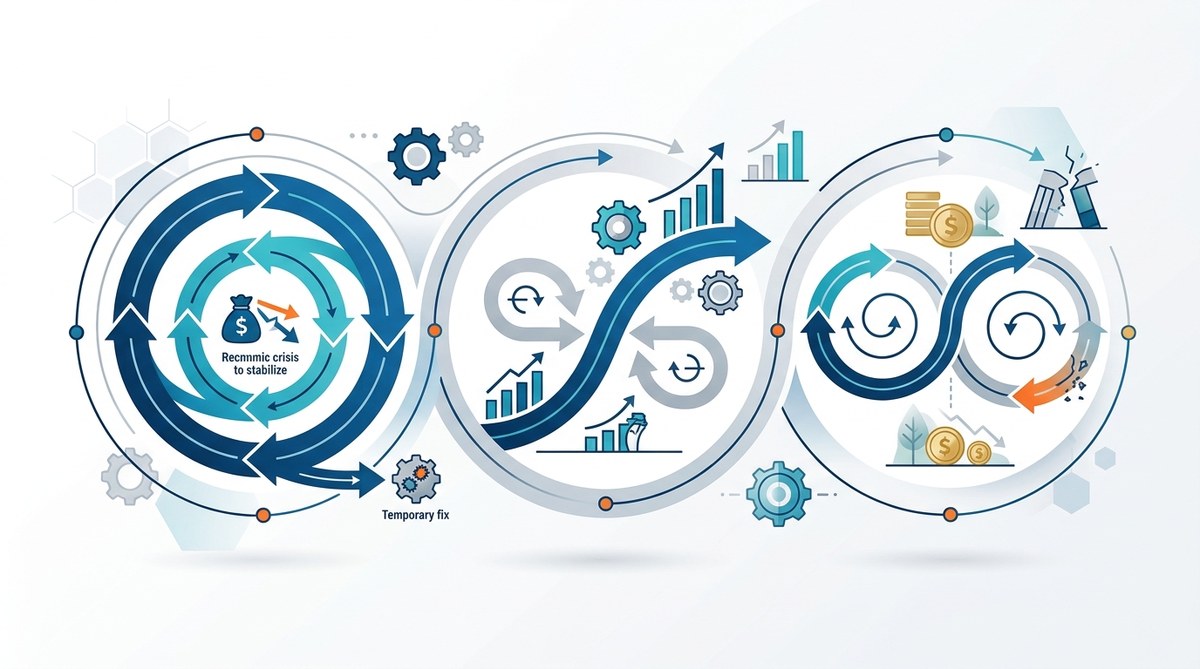
Economic reforms fail not because of poor intentions but because of hidden system structures. Three archetypes dominate: Policy Resistance, where opposing forces neutralize change; Fixes That Fail, where short-term solutions create long-term damage; and Shifting the Burden, where symptom relief replaces root cause treatment. Recognizing these patterns helps policymakers design reforms that actually stick.
The Hidden Architecture of Policy Failure
Standard economics treats reforms as if they happen in a vacuum. You change a variable (the interest rate, the tariff level, the minimum wage) and you expect a linear outcome. But real economies are not machines. They are living systems filled with people, businesses, and institutions that react, adapt, and push back.
This is where systems thinking becomes invaluable. A systems lens reveals that the structure of relationships between actors often matters more than the policy itself. If you want to understand why economic reforms fail, you must look at the feedback loops, the delays, and the hidden counterforces that emerge after a policy is announced.
Milan Zeleny’s work on the 3 system archetypes that predict why most economic reforms fail provides a powerful framework for this analysis. These archetypes are not abstract theories. They are observable, recurring patterns that play out in real time.
Archetype One: Policy Resistance
This is the most common reason why economic reforms fail. Policy resistance occurs when a system pushes back against a change because its internal goals are different from the policy’s goals.
Imagine a government trying to reduce inflation by raising interest rates. The central bank acts. Businesses react by cutting investment. Consumers react by spending less. Inflation dips. But then, unemployment rises. The public protests. The government, under pressure, lowers rates again. The system has resisted the change by creating an undesirable side effect that forces a reversal.
Here is a practical list of signs that policy resistance is at work:
- The reform creates a powerful new coalition of losers who organize against it.
- Initial positive results are followed by a slow, grinding reversal.
- The policy requires constant enforcement to maintain any effect.
- Opponents of the reform use the system’s own rules to block implementation.
Policy resistance is not about bad faith. It is about structural misalignment. The system’s internal balancing loops are stronger than the policy’s forcing loops.
Archetype Two: Fixes That Fail
This archetype is particularly dangerous because it looks like progress in the short term. A fix is applied to a problem. The fix works immediately. Everyone celebrates. But the fix creates a delayed side effect that makes the original problem worse.
Consider a country with a chronic trade deficit. The government decides to devalue the currency. Exports become cheaper. Imports become more expensive. The trade deficit improves for about six months. But then, the cost of imported raw materials rises, hurting domestic manufacturers. Inflation spikes. Investor confidence drops. The currency comes under pressure again. The original problem is now larger than before.
The table below compares the typical cycle of a successful reform versus a “Fixes That Fail” cycle:
| Stage | Successful Reform | Fixes That Fail |
|---|---|---|
| Problem identified | Clear, systemic diagnosis | Symptom identified |
| Action taken | Addresses root cause | Applies quick fix |
| Short-term result | Slow, steady improvement | Immediate relief |
| Long-term result | Sustainable change | Problem returns, worse |
| System response | Stabilizes | Generates new side effects |
The tragedy of this archetype is that the fix is often politically necessary. A leader cannot say, “We need to suffer for five years.” They need a win now. But that win plants the seeds for the next crisis.
Archetype Three: Shifting the Burden
This archetype explains why economic reforms fail even when everyone agrees on the goals. Shifting the burden happens when a short-term solution relieves a symptom, which then reduces the pressure to solve the underlying problem.
A classic example is foreign aid that props up a failing state. The aid prevents an immediate collapse. People get food. The currency does not crash. But the government never reforms its tax collection system because there is no crisis forcing it to. The aid becomes a permanent crutch. The underlying dysfunction never gets addressed.
The key characteristics of shifting the burden include:
- A recurring need for the same intervention year after year.
- The original problem never gets smaller, only more dependent on the fix.
- Local capacity to solve the problem atrophies over time.
- Experts recommend more of the same fix rather than a structural change.
This pattern is especially common in countries with weak institutions. The reform itself becomes a ritual. Everyone goes through the motions, but the system’s fundamental architecture remains unchanged.
A Step-by-Step Process to Diagnose These Archetypes
If you are a policy analyst or a government advisor, you can use this process to evaluate any proposed reform before it is implemented. This is not about predicting the future. It is about stress-testing the policy against known failure modes.
-
Map the key actors and their goals. List every group that will be affected by the reform. What does each group want? What are their non-negotiable interests? If the reform threatens a core goal of a powerful actor, expect policy resistance.
-
Identify the feedback loops. Draw the causal connections. If you do X, what happens to Y? And then what happens back to X? Look for loops that could neutralize the reform’s effect. A single reinforcing loop can undo a year of legislative work.
-
Check for time delays. When will the side effects appear? If the positive effects show up in six months but the negative effects take three years, the reform is vulnerable. Politicians will claim victory before the bill comes due.
-
Ask who benefits from the status quo. This is the hardest question. Every system has beneficiaries who will fight to preserve it. If you cannot name them, you have not looked hard enough. Their resistance is the most reliable predictor of failure.
-
Test for addiction. Will the reform create dependency? If the system cannot survive without the reform after five years, you have shifted the burden. You have not solved the problem. You have just become its caretaker.
This process is not a guarantee of success. But it dramatically reduces the odds of being surprised by a predictable failure.
What Behavioral Economics Adds to the Picture
Systems thinking explains the structural reasons why economic reforms fail. Behavioral economics explains the human reasons. The two perspectives are complementary.
People have cognitive biases that make them prefer short-term fixes over long-term solutions. This is called present bias. Politicians, being human, are especially susceptible. They want results before the next election. This bias aligns perfectly with the “Fixes That Fail” archetype.
There is also the status quo bias. People prefer things to stay the same, even when change would benefit them. This bias feeds policy resistance. A reform that requires millions of people to change their behavior will meet resistance not because the reform is bad, but because change is hard.
Understanding these biases does not make them disappear. But it does allow you to design reforms that account for them. For example, you can build in automatic triggers that prevent a policy from being reversed too easily. You can create sunset clauses that force reevaluation. You can use defaults to guide behavior without coercion.
For a deeper look at how these concepts connect, read about how systems thinking reveals the true drivers of organizational performance. The same principles apply at the national level.
The Danger of Ignoring System Traps
Many reformers believe they can overcome system dynamics through sheer force of will. They think a strong leader, a clear plan, and enough money are sufficient. History suggests otherwise.
The most dramatic failures often come from countries that tried to bypass the system entirely. They imposed price controls, banned strikes, or nationalized industries without understanding the underlying feedback loops. The system did not break. It adapted. Black markets emerged. Productivity collapsed. The reform became a new source of instability.
“The system always finds a way to express its own logic. You can override it for a while, but the cost of that override grows exponentially. The smartest reform is not the one that fights the system. It is the one that works with the system’s natural flow.”
This quote from a senior economic advisor in Southeast Asia captures the essence of systems-aware reform. You cannot defeat the system. You can only redirect it.
Building Resilience Into Reform Design
If the goal is to make reforms that last, the design process must change. Here are the principles that separate successful reforms from the failed ones:
-
Start small and scale. Test the reform on a limited population first. Learn from the resistance. Adjust the design. Then expand. This is how successful tax reforms have been implemented in places like Estonia and New Zealand.
-
Build in feedback loops. Create mechanisms that measure the reform’s actual effects, not just the intended ones. If the data shows policy resistance forming, you can adapt before the resistance becomes overwhelming.
-
Align incentives with the system’s goals. Do not fight the system’s natural tendencies. Use them. If businesses want stability, design a reform that offers stability in exchange for compliance. If citizens fear uncertainty, phase the reform in gradually.
-
Create a coalition for the long term. Short-term coalitions collapse when the initial crisis passes. Build a coalition that has a stake in the reform’s long-term success. This might mean giving beneficiaries a role in oversight or creating a watchdog group with real power.
-
Plan for the reversal. Assume that someone will try to undo the reform. Design it so that reversal is costly or difficult. This is called “locking in” the reform. It is not anti-democratic. It is honest about the reality that systems resist change.
These principles are derived from decades of case studies. They are not theoretical. They come from observing what worked and what did not.
How Systems Thinking Reshapes Economic Policy
The traditional approach to economic reform is linear. Identify a problem. Design a solution. Implement it. Measure the result. This approach works well for simple problems but fails for complex ones.
Systems thinking offers an alternative. It treats the economy as a dynamic, adaptive network. It acknowledges that policies create reactions, which create counter-reactions, which create new problems. It accepts that you cannot control the system. You can only influence it.
This shift in mindset has practical implications. For example, a systems-aware reformer does not ask, “How do I lower unemployment?” They ask, “What are the feedback loops keeping unemployment high?” The answer might be a skill mismatch, a housing policy that traps people in low-productivity areas, or a credit system that favors large firms over small ones. The reform then targets those loops, not the symptom.
If this approach interests you, consider reading about how to identify leverage points that transform stagnant economic systems. It provides a practical method for finding the places where a small change can produce a large effect.
A Final Look at the Three Archetypes in Practice
Let us revisit the three archetypes with a concrete example. Imagine a country with high youth unemployment. The government launches a training program.
If the program faces policy resistance, employers might refuse to hire the trainees because they distrust the certification. Unions might oppose it because they see it as undermining wage standards. The program stalls.
If the program is a fix that fails, it might place 10,000 young people in temporary jobs immediately. The unemployment numbers drop. But the jobs are low-skill and dead-end. Two years later, those same workers are unemployed again, and they now have a gap in their resume. The problem is worse.
If the program is a shifted burden, the government might pour money into the training program every year without ever reforming the education system that produced the unemployable graduates in the first place. The program becomes a permanent expense. The root cause never gets addressed.
Recognizing which archetype is at play allows the reformer to adjust the design. If policy resistance is likely, the reformer invests in stakeholder negotiations before launching. If a fix that fails is a risk, the reformer builds in a long-term follow-up mechanism. If shifting the burden is the danger, the reformer ties funding to systemic changes in the education sector.
What This Means for You
If you work in policy, your job is not just to design reforms. It is to understand the system you are trying to change. The three archetypes are diagnostic tools. Use them to check your assumptions before you commit to a course of action.
If you are a student or an analyst, these archetypes give you a framework for evaluating why past reforms failed. Look at any major policy initiative from the last fifty years. Chances are, one of these three patterns explains the outcome.
The goal is not to avoid failure entirely. Some failure is inevitable. The goal is to avoid the kind of failure that wastes resources, destroys trust, and makes future reforms harder. The kind of failure that happens because no one looked at the system.
Start applying this framework today. The next time you read about a new reform, ask yourself: which archetype is most likely to appear? What would the system’s resistance look like? How could the design be changed to account for it? These questions will make you a better analyst, a better advisor, and a better advocate for change that actually works.
Leave a Reply