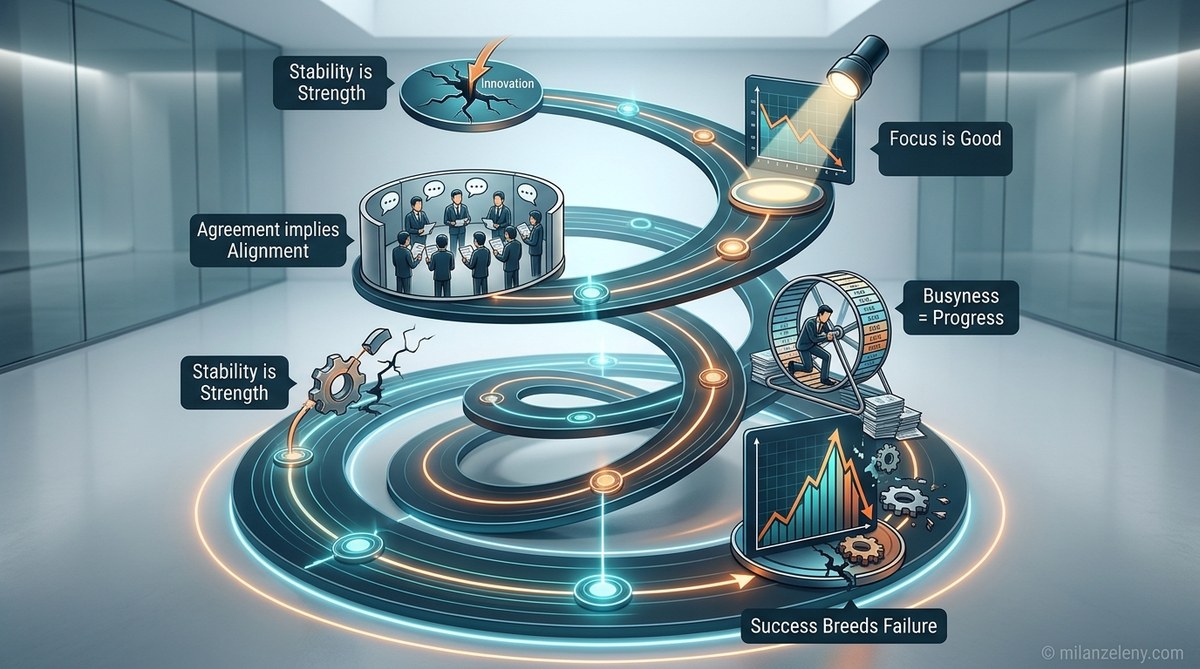
You walk into the Monday morning leadership meeting. The energy is low. The same problems from last quarter are back on the agenda. Everyone nods along as the VP of Operations explains that they need to “push harder” on the current initiative. The CFO agrees, saying they need to “double down” on the strategy that worked last year. Something feels off, but you cannot put your finger on it. The team is working harder than ever. Revenue is stable. Yet innovation has stalled. New ideas feel risky. Change feels impossible.
What you are sensing is a reinforcing feedback loop. It is a cycle where a small change in one direction gets amplified over time, pushing the organization further in that direction. When these loops are healthy, they drive growth and learning. When they are trapped, they become engines of rigidity. The hardest part? The signs are often invisible to the people inside the system. The very behaviors that look like strength are actually symptoms of a trap.
Here is how to spot the counterintuitive signs that your organization is stuck in a reinforcing feedback loop that is silently blocking innovation.
Reinforcing feedback loops often disguise themselves as signs of discipline or focus. When your team celebrates consistency, rewards efficiency, and avoids conflict, those behaviors can amplify rigidity. The most dangerous loops are the ones that feel productive. Learning to see them is the first step toward breaking free and restoring adaptive capacity.
The Paradox of Productive Stagnation
A reinforcing feedback loop works like a snowball rolling downhill. It picks up more snow, grows larger, and gains momentum. In organizations, this happens when an action produces a result that encourages more of the same action. Over time, the system locks into a single trajectory.
The trap is that these loops feel good at first. They produce predictable outcomes. They reduce uncertainty. The team feels aligned. But when the loop is built on a flawed assumption or a narrow goal, the organization accelerates in the wrong direction. It becomes hyper-efficient at doing the wrong things.
Let us look at the five counterintuitive signs that reveal this hidden trap.
1. Your Team Celebrates “Getting It Done” More Than “Figuring It Out”
When was the last time someone in your organization was praised for changing their mind? For abandoning a project because new data suggested a better path? If the answer is “rarely,” you may be trapped in a reinforcing loop that rewards closure over curiosity.
Here is how this loop works:
- A team completes a project on time.
- Leadership celebrates the execution.
- Team members internalize that speed and completion are the highest values.
- On the next project, they prioritize finishing over learning.
- They skip the reflection phase. They ignore early warning signs.
- They finish the next project too, but the quality drops.
- Leadership celebrates the speed again, reinforcing the behavior.
The loop amplifies a culture of “done is better than good.” Over time, the organization loses its ability to sense when a project should be stopped or redirected. The loop feeds itself. The more you finish, the more you are rewarded for finishing, so you finish more.
2. Your Best People Are the Most Exhausted
High performers often carry the heaviest load. In a trapped reinforcing loop, their workload grows exponentially because the system rewards their reliability.
Consider this pattern:
- A high performer delivers exceptional results.
- They are assigned more responsibility.
- They deliver again, so they get even more work.
- Other team members step back, assuming the high performer has it covered.
- The high performer becomes a bottleneck.
- They burn out, but the organization keeps feeding them work because it is the path of least resistance.
This is a classic reinforcing loop. The more capable someone appears, the more they are asked to do. The more they do, the more capable they appear. Meanwhile, the organization never builds capacity in others. It becomes dependent on a few heroes. When they leave, the system collapses.
3. Your Metrics Are Improving, but Your Strategy Is Not
It is possible to hit every quarterly target and still be heading toward a cliff. Reinforcing feedback loops often optimize for the wrong variables.
Imagine a sales team that is measured on the number of new accounts closed. They focus on small, easy-to-close deals. The numbers go up. Leadership rewards the team. The team doubles down on small deals. They stop pursuing larger, more complex opportunities because those take longer and hurt the metric. The metric looks great. The business is actually shrinking its total addressable value.
The reinforcing loop is:
- Focus on the metric.
- Metric improves.
- Reward the behavior.
- Focus more narrowly on the metric.
- Metric keeps improving.
- Strategic drift accelerates.
The numbers tell a story of success. The reality tells a story of decline. If your team is hitting all its targets but the overall strategy feels stagnant, you are likely inside a reinforcing loop that is optimizing for the wrong thing.
4. Conflict Has Disappeared from Meetings
Healthy organizations have productive disagreement. When conflict vanishes, it is often a sign that a reinforcing loop has silenced dissent.
Here is the loop:
- A leader expresses a strong opinion.
- Team members agree to avoid tension.
- The leader interprets agreement as validation.
- The leader expresses stronger opinions next time.
- Team members suppress their concerns even more.
- The leader becomes more confident in their views.
- The organization loses access to critical information.
This is sometimes called the “agreement loop.” It reinforces the leader’s confidence while eroding the team’s willingness to challenge. The more people agree, the less they think. The less they think, the more they agree. Over time, the organization becomes blind to its own blind spots.
5. Your “Process Improvement” Initiatives Never End
Ironically, the pursuit of efficiency can create a reinforcing loop that destroys adaptability.
- The team implements a new process to reduce errors.
- Errors drop. The process is deemed successful.
- The team adds more steps to prevent future errors.
- The process becomes more rigid.
- The team spends more time managing the process than doing the work.
- Errors drop further because no one is taking risks.
- The process is expanded again.
The loop reinforces itself. Each improvement feels necessary. Each new step feels like progress. But the cumulative effect is a system that is optimized for zero errors and zero innovation. The organization becomes brittle. When the market shifts, the process cannot adapt because it was designed to prevent change, not enable it.
How to Diagnose a Reinforcing Feedback Loop in Your Organization
If any of these signs feel familiar, you can take action. The first step is to map the loop. Here is a simple numbered process to follow:
- Identify the behavior that is being amplified. Look for an action that keeps increasing. It could be meetings, approvals, reports, or even silence.
- Find the reward mechanism. What is reinforcing that behavior? Is it praise, promotions, budget increases, or simply the absence of negative consequences?
- Trace the consequences. What is the loop producing? Are you getting more of what you want, or more of what you do not want?
- Look for the balancing feedback that is missing. A healthy system has counteracting forces. If you cannot find any, you are likely trapped in a runaway loop.
- Intervene at the reward point. Change what gets rewarded. If you stop celebrating “getting it done” and start celebrating “figuring it out,” the loop shifts.
Common Diagnostic Mistakes and Better Approaches
| Mistake | Why It Fails | Better Approach |
|---|---|---|
| Blaming individuals for the loop | People are usually acting rationally within the system. The loop will persist even if you replace them. | Map the structure, not the person. Ask: “What incentives are driving this behavior?” |
| Trying to stop the loop with willpower | You cannot out-muscle a system. Telling people to “try harder” only reinforces the existing loop. | Change the rules of the game. Alter the feedback mechanism. |
| Focusing only on the symptoms | Low morale, high turnover, and missed deadlines are outputs. Treating them directly ignores the loop that creates them. | Focus on the pattern of reinforcement. Ask: “What is causing this pattern to repeat?” |
| Assuming data will fix the problem | More data often reinforces the existing loop because people interpret data through their current mental models. | Use data to challenge assumptions, not confirm them. Ask: “What would have to be true for our data to be misleading?” |
“The most dangerous reinforcing loops are the ones that feel like strengths. When your organization prides itself on consistency, you are one step away from rigidity. When it celebrates efficiency, you are one step away from fragility. The goal is not to eliminate loops. The goal is to ensure they serve your long-term health, not just your short-term comfort.”
Breaking the Loop Requires a Systemic Intervention
You cannot break a reinforcing feedback loop by working harder within it. You have to change the structure. Here are several practical ways to do that:
- Introduce a new variable. Add a metric that measures learning, not just output. Track how many experiments were run, not just how many succeeded.
- Create a forcing function for reflection. Schedule a “post-mortem” after every major project. Make it a rule that no one can leave without naming one thing they would do differently.
- Rotate leadership roles. Give different people the chance to set the agenda. This disrupts the agreement loop by introducing new perspectives.
- Reward dissent publicly. When someone challenges a popular idea, thank them in front of the team. This weakens the reinforcing loop that rewards silence.
- Set limits on process growth. Cap the number of steps in any approval workflow. If a process exceeds the cap, something else must be removed.
Each of these actions introduces a balancing force. They do not destroy the reinforcing loop. They create a counterweight that keeps the system from spinning out of control.
How to Spot the Loop Before It Traps You
It is easier to prevent a reinforcing loop from hardening than to break one that is already entrenched. Here is a bulleted list of early warning signs to watch for:
- People stop asking “why” in meetings.
- The same topics appear on every agenda.
- Your team has stopped tracking failures.
- New hires quickly adopt the existing culture without questioning it.
- Leaders use phrases like “that is just how we do things here.”
- Your best ideas come from outside the organization, not from within.
- The annual strategy document looks the same as last year’s.
- No one can remember the last time a major decision was reversed.
If any of these sound familiar, you may be in the early stages of a reinforcing feedback loop. The good news is that early loops are easier to redirect.
Why Traditional Change Management Fails in These Systems
Most change management frameworks assume that people resist change because they are lazy or afraid. That is often wrong. People resist change because the system punishes them for it. The reinforcing loop actively discourages deviation.
When you try to introduce a new initiative, the loop pushes back. The more you push, the stronger the resistance becomes. This is why top-down change efforts often fail. They trigger the very loop they are trying to break.
A better approach is to identify the loop’s leverage point. Instead of pushing against the loop, change the information that feeds it. If the loop rewards speed, start measuring quality. If it rewards agreement, start measuring constructive challenge. The loop will naturally rebalance.
The Path Forward: From Rigidity to Resilience
Reinforcing feedback loops are not inherently bad. They are the engines of growth, learning, and momentum. The problem is not the loop itself. It is the lack of countervailing forces. A healthy system has both reinforcing and balancing loops. The reinforcing loop drives progress. The balancing loop prevents runaway behavior.
When you spot a reinforcing feedback loop in your organization, do not try to destroy it. Instead, ask yourself: “What balancing loop is missing?” That is where your intervention lives.
If you want to go deeper into this topic, you might find value in how systems thinking exposes hidden feedback loops in your business strategy. It offers a framework for mapping the loops that are invisible to most leaders.
The Real Test of Leadership
The most counterintuitive sign of a trapped reinforcing feedback loop is this: your organization feels calm. There is no drama. No crisis. No urgent calls for change. Everyone is busy. Everyone is aligned. The machine is running smoothly.
That calm is the danger.
When a system is perfectly stable, it has no internal pressure to change. The reinforcing loop has reached equilibrium. It is efficient, predictable, and brittle. The first major disruption will shatter it because the organization has lost its adaptive capacity.
Real leadership in 2026 means being willing to disturb the calm. It means introducing productive friction. It means asking the uncomfortable question: “What are we optimizing for, and is it still the right thing?”
If you are ready to take that step, consider reading about how systems thinking reveals the true drivers of organizational performance. It will help you see the hidden structures that shape your team’s behavior.
A Final Reflection
The next time your team finishes a project on time, on budget, and with zero drama, pause. Ask yourself: “Is this a sign of health, or a sign of a reinforcing loop that has silenced dissent, narrowed focus, and eliminated risk?” The answer might surprise you.
Your job as a leader is not to keep the machine running. It is to make sure the machine is pointed in the right direction. Sometimes, that means slowing it down. Sometimes, it means stopping it entirely. And sometimes, it means letting the snowball melt so you can build a better one.
Start small. Pick one sign from this article and look for it in your next meeting. You might be surprised by what you see.
Leave a Reply