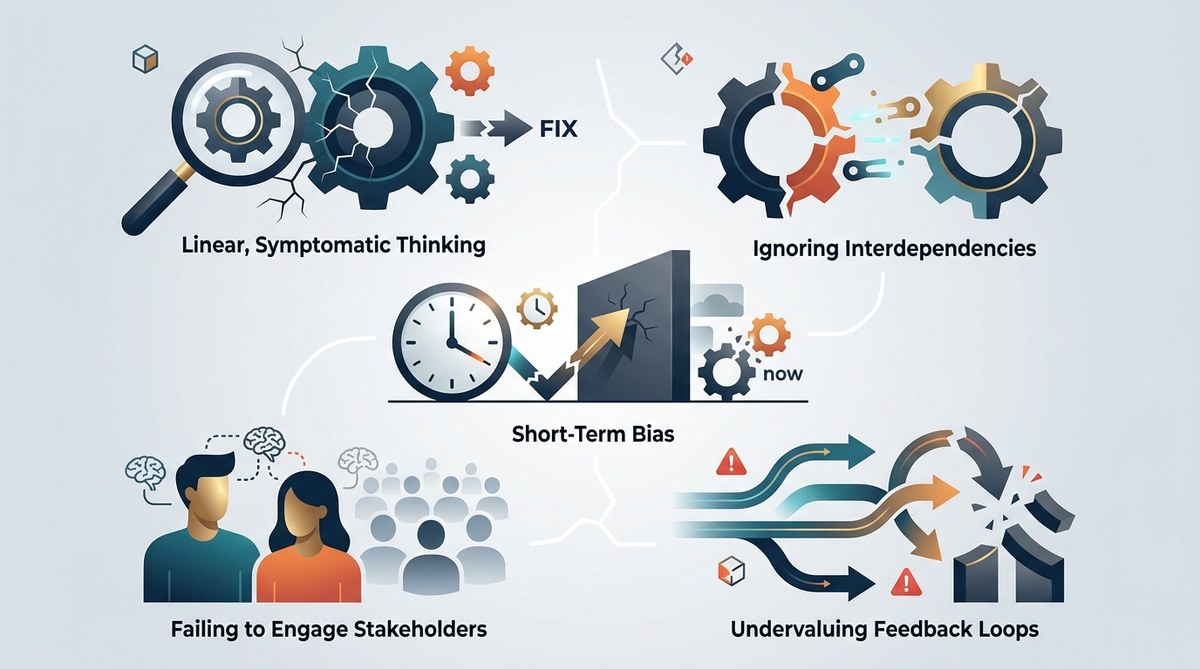
Why do so many organizational change initiatives fail even when leaders do everything “right”? You launch a new process, roll out a new tool, or restructure a department. You communicate the vision. You get buy-in from key stakeholders. Yet months later, nothing has really changed. The old habits creep back. The alignment dissolves. The promised results never materialize.
The problem often isn’t your change strategy. It’s how you think about the system itself. Systems thinking offers a powerful lens for seeing the whole picture, but it’s also easy to misuse. When leaders apply systems thinking in incomplete or shallow ways, they make mistakes that actively derail transformation. Understanding these systems thinking change management mistakes is the first step to avoiding them.
Many change efforts fail because leaders misunderstand how systems truly work. They treat symptoms, ignore feedback loops, or assume linear cause and effect. By recognizing five common systems thinking mistakes, you can design transformations that respect complexity, build lasting shifts, and avoid the traps that make 70% of change initiatives stall out.
Mistake 1: Fixing the Symptom Instead of the Pattern
You see an issue: sales are dropping, turnover is high, or project delivery is consistently late. It’s natural to want to fix that symptom right away. In fact, most change management focuses on correcting visible problems. But systems thinking teaches us that symptoms are often outputs of deeper structures.
A common mistake is to treat the symptom as the root cause. For example, if employee engagement scores are low, leadership might launch a wellness program or add perks. Those actions might temporarily bump the numbers, but they don’t address the underlying system that drains engagement. Perhaps managers lack autonomy, or performance reviews reward the wrong behaviors.
The real leverage lies in understanding the patterns that produce the symptom. Ask yourself: what recurring dynamics create this outcome? That is where lasting change happens. If you only fix the symptom, the system will keep producing the same problem. This is one of the most frequent systems thinking change management mistakes, because it feels productive in the moment.
“A problem never exists in isolation. It is part of a larger pattern. If you try to solve the problem without understanding the pattern, the pattern will recreate the problem.” This insight from systems thinking pioneer Donella Meadows reminds us to look for structure, not events.
Mistake 2: Ignoring Feedback Loops and Delays
Every system has feedback loops: reinforcing loops that amplify change and balancing loops that resist it. Change initiatives often fail because leaders only see the reinforcing loop they want, like “more training leads to better performance.” They forget about balancing loops that push back, like “more training takes time away from daily work, which reduces output and frustrates managers.”
Delays between action and result are another blind spot. You implement a new CRM system and expect productivity gains within a quarter. But the real benefits may take six months or more. In the meantime, the balancing loops (resistance, learning curve, lost data) dominate. If you don’t account for that delay, you might conclude the change isn’t working and abandon it prematurely.
To avoid this mistake, map out the feedback loops before starting the change. Identify both the forces that will help and those that will resist. Plan for the delay: set intermediate milestones that measure progress on enablers, not just outcomes. For more on how feedback loops can expose hidden dynamics in your strategy, read about how systems thinking exposes hidden feedback loops in your business strategy.
Mistake 3: Treating the Organization as a Closed System
Many change plans assume the organization is a self-contained unit. Leaders create detailed internal rollouts, communication plans, and training schedules. But a real system is open. It interacts with customers, suppliers, regulators, competitors, and broader economic forces. Ignoring those external connections is a classic systems thinking error.
Say you restructure your supply chain team to improve efficiency. You redesign workflows and shift responsibilities. But you don’t consider that your key supplier is also restructuring, causing delays. Or that a new regulation will require additional compliance steps. The change fails not because the internal plan was bad, but because the system extended beyond your boundaries.
A better approach is to map the relevant external stakeholders and influences at the start. Ask: what external forces will interact with this change? How might they shift during the implementation? Build scenario plans that account for external shocks. For a deeper understanding of how systems thinking applies to external economic pressures, check out the untapped power of systems thinking in reshaping global economic policies.
Mistake 4: Overlooking Unintended Second-Order Effects
When you change one part of a system, other parts shift too. Sometimes those shifts are beneficial; often they’re unexpected. A classic example: a company introduces a new performance metric to reduce costs. Employees respond by cutting corners on quality. Costs go down, but customer satisfaction plummets. The metric succeeded in its goal, but the system produced a worse overall outcome.
This happens because leaders think linearly. They assume A leads to B. But in a complex system, A leads to B, which leads to C, which loops back to A. Second-order effects can take months to surface. By then, the original change looks like a failure, and leaders scramble for another fix.
To prevent unintended consequences, run thought experiments before implementing. Ask: “If we make this change, what else might change as a result? Who will adapt, and how?” Use a causal loop diagram to visualize potential ripple effects. For more on building strategies that handle complexity, see how systems thinking can revolutionize business strategy in 2026.
Mistake 5: Assuming Change Is a One-Time Event
Systems thinking tells us that systems are dynamic. They evolve, adapt, and seek equilibrium. Yet many change initiatives are designed as discrete projects with a start and end date. “We’ll implement this new process by Q3, and then we’re done.” That linear approach ignores the reality that the system will continue to adjust long after the official rollout.
A one-time change effort might succeed in shifting the structure, but the culture, habits, and informal networks will keep exerting their influence. Without ongoing reinforcement, the system often reverts to its old state. This is why many transformations show excellent early results and then fade. The system is not a machine that holds its new shape; it’s a living organism that constantly rebalances.
Instead, treat change as an ongoing process of adaptation. Build in periodic reviews, adjust based on feedback, and recognize that the system will never be “finished.” The most resilient organizations are those that embrace continuous learning. For a practical toolkit to navigate this, look at 5 systems thinking tools to navigate complexity in 2026.
| Mistake | What It Looks Like | How to Correct It |
|---|---|---|
| Fixing symptoms | Adding perks to fix low engagement | Identify patterns and root structures |
| Ignoring feedback loops | Rushing change without anticipating resistance | Map reinforcing and balancing loops |
| Treating as closed system | Internal rollout ignores external factors | Map external stakeholders and influences |
| Overlooking second-order effects | New metric reduces costs but hurts quality | Run causal loop simulations before action |
| Treating change as one-time | Project ends but system drifts back | Build continuous adaptation and review cycles |
A Practical Process to Avoid These Mistakes
Here is a simple three-step process you can use before your next major change initiative. It will help you spot the most common systems thinking change management mistakes early.
-
Map the system before planning the change. Draw a simple diagram of the current state. Include the main actors, the flows of information and resources, and the feedback loops. Don’t forget external influences. This map will be your reality check.
-
Identify potential unintended consequences. For each planned change, ask “What else might shift?” List at least three possible second-order effects. Then decide if you can mitigate them or if the change needs adjustment.
-
Build in review points at regular intervals. Don’t set a single “go live” date and forget it. Schedule check-ins at 30, 60, and 90 days after launch. Use these to assess not just the primary metrics but also the side effects. Adjust as you learn.
This process works because it keeps you grounded in systemic reality rather than wishful thinking.
How to Spot These Mistakes Early
Leaders committed to avoiding systems thinking change management mistakes need to develop new habits. Here are some signs that you might be falling into one of these traps:
- You hear phrases like “We just need to fix this one thing.”
- The change plan has precise dates but no contingency for delays.
- No one has talked about what could go wrong.
- The pilot results look great, but you haven’t considered how the rest of the organization differs.
- You assume that once the change is implemented, your job is done.
If any of these sound familiar, step back and reapply the systems lens. It might save you months of wasted effort. For a broader view of how systems thinking transforms management, read about applying systems thinking to transform modern management practices.
Learning to Think in Systems Without Overthinking
Some managers worry that systems thinking is too abstract or time-consuming. It doesn’t have to be. You don’t need to become an expert in complex modeling. Start small. Pick one upcoming change and spend an hour mapping the system. Talk to people in different parts of the organization to see the system from their perspective. You will quickly notice patterns you missed before.
The goal is not to predict everything perfectly. It’s to reduce the blind spots that cause so many change efforts to fail. Each mistake we covered is a blind spot. By recognizing them, you can design with more humility and more accuracy.
Systems thinking is not a silver bullet. It won’t eliminate all resistance or guarantee success. But it will help you avoid the most common systems thinking change management mistakes that quietly undermine even the best-intentioned transformations. And that alone increases your odds of making change that actually sticks.
Putting These Insights Into Action
The next time you plan a change initiative, run through this checklist:
- Did we identify the pattern, not just the symptom?
- Have we mapped feedback loops, including delays and resistance?
- Did we consider external forces?
- Are we prepared for unintended second-order effects?
- Is our plan set up for continuous adaptation, not a one-time event?
If you answer no to any of these, go back and adjust. Your future self will thank you. Real change is messy, but with a better systems lens, you can navigate the mess with confidence and clarity.
Leave a Reply